Introduction
If the tip of your penis has become red, sore, itchy or swollen — and pulling the foreskin back has started to hurt — it is understandable to feel worried and more than a little embarrassed. Many men quietly search for answers at 2 a.m. before they ever mention it to a doctor.
Here is the reassuring part: what you are describing is one of the most common conditions a urologist sees, it has a name, and in the large majority of cases it settles with simple, targeted treatment.
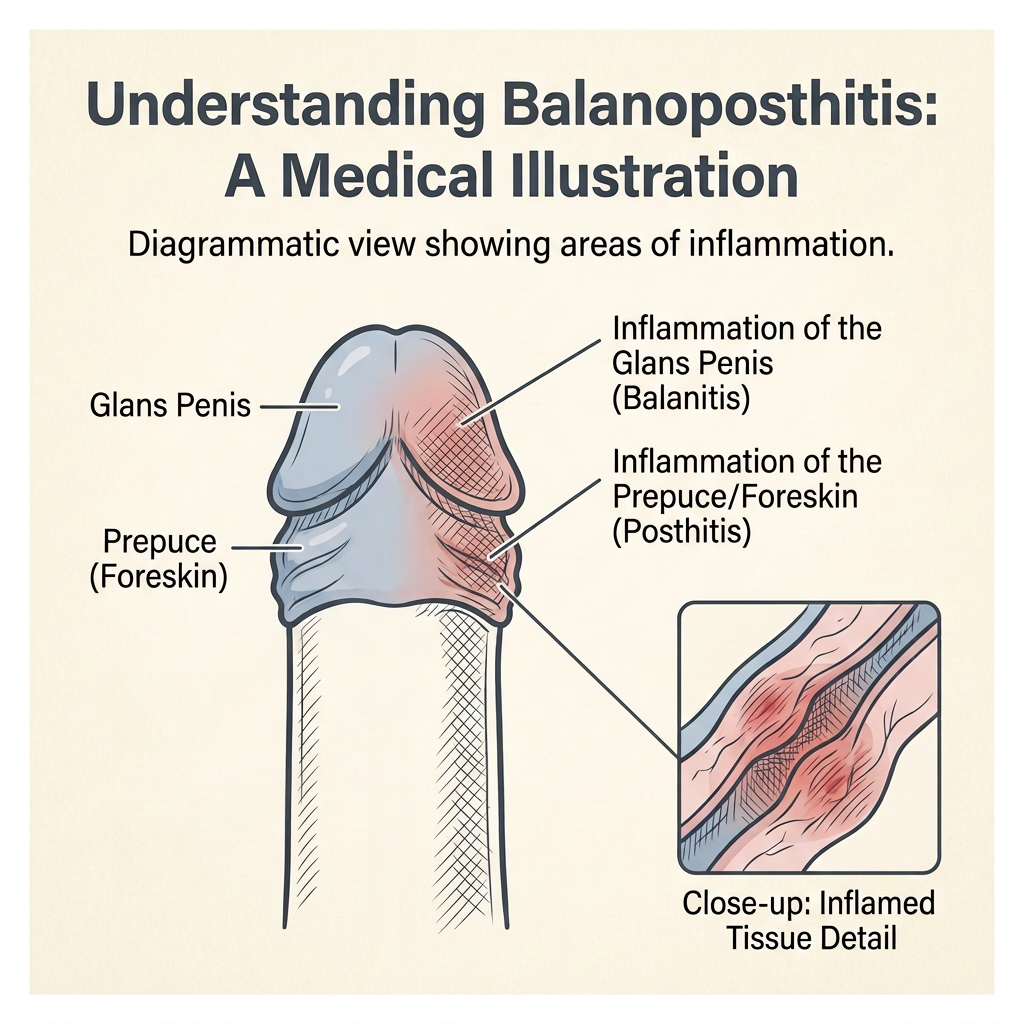
Balanoposthitis means inflammation of both the glans (the head of the penis) and the prepuce (the foreskin). When only the glans is inflamed, it is called balanitis. When only the foreskin is inflamed, it is called posthitis. Because the two surfaces sit against each other, they very often become inflamed together.
Balanoposthitis is not rare. Studies suggest it affects roughly 12% to 20% of males at some point, and the figure is considerably higher in uncircumcised men living with diabetes.
This guide explains, in plain language, what causes balanoposthitis, how it is properly diagnosed, the full range of treatment options from simple creams to surgery, and — importantly — what the warning signs are that mean you should not wait.

What Is Balanoposthitis?
Balanoposthitis is inflammation of the head of the penis and the foreskin occurring together. “Inflammation” simply means the tissue has become red, swollen, warm and irritated in response to something — an infection, an irritant, an allergy, or an underlying skin disease.
To understand why this area is vulnerable, it helps to picture the anatomy. In an uncircumcised man, the foreskin folds over the glans, creating a warm, moist, enclosed pocket called the subpreputial space. Natural secretions, shed skin cells and moisture collect here as smegma. In a healthy, easily retractable foreskin that gets rinsed daily, this causes no trouble at all.
Problems begin when that space stops being cleaned and aired properly — because the foreskin is tight, because hygiene has lapsed, because soap residue irritates the skin, or because sugar in the urine of an undiagnosed diabetic turns the pocket into an ideal environment for yeast to multiply.
Two important points to hold onto:
- Balanoposthitis is a description, not a single disease. It is a pattern of inflammation with many possible underlying causes — and identifying which cause is what makes treatment work.
- It is uncommon in circumcised men, which tells us that foreskin function and the subpreputial environment are central to the problem.
Balanoposthitis can be acute (a single episode lasting days to a couple of weeks) or recurrent/chronic (returning again and again, sometimes for months or years). Recurrent disease always deserves a proper hunt for the underlying reason rather than another round of the same cream.
Causes of Balanoposthitis
The causes fall into four broad groups: infections, irritants and allergies, skin diseases, and pre-cancerous conditions. Getting this categorisation right is the single most important step in treatment.
Infectious causes
- Candida (yeast) infection — the most common infectious cause. Candida albicans is a yeast that lives harmlessly on the skin but overgrows in warm, moist, sugar-rich conditions. It classically produces a red, itchy, sometimes slightly “cheesy” white coating on the glans. It is strongly linked to diabetes.
- Aerobic bacteria — chiefly Streptococcus pyogenes (Group A streptococcus) and Staphylococcus aureus. These tend to produce a brighter, more painful, sometimes weepy inflammation.
- Anaerobic bacteria — organisms that thrive without oxygen, exactly as in a closed subpreputial pocket. The hallmark is a foul-smelling discharge with swelling and sometimes ulceration.
- Sexually transmitted infections — including Trichomonas vaginalis, herpes simplex virus (which causes painful blisters and ulcers), syphilis, and human papillomavirus. An STI screen is part of good practice when the history suggests it.
- Mixed infections — very common in real life, particularly when the problem has been present for a while.
Irritant and allergic causes
- Poor or excessive hygiene — both extremes cause problems. Under-washing lets smegma and bacteria accumulate; over-washing with harsh soap strips the skin’s protective barrier.
- Soaps, shower gels, detergents and antiseptics — a very frequent and much-underestimated cause of chronic redness and burning.
- Latex condoms and spermicides — allergic contact dermatitis from latex proteins or nonoxynol-9.
- Retained urine and moisture — dribbling after urination, obesity, or difficulty retracting the foreskin all leave irritant urine in contact with delicate skin.
- Trauma and friction — vigorous sexual activity, a tight foreskin being forcibly retracted, or a zip injury.
Inflammatory skin conditions (dermatoses)
- Lichen sclerosus (also called balanitis xerotica obliterans, or BXO) — a chronic scarring skin disease producing white, thickened, tight patches on the glans and foreskin. It is a leading cause of acquired phimosis in adults and needs specialist management.
- Lichen planus — an immune-mediated condition producing violet-coloured, sometimes erosive patches.
- Psoriasis and eczema — genital psoriasis often looks different from psoriasis elsewhere; the typical scale is usually absent in the moist genital environment.
- Zoon’s balanitis (plasma cell balanitis) — a distinctive shiny, orange-red, “cayenne-pepper-speckled” patch, seen in uncircumcised men usually over 40, thought to relate to chronic irritation from a poorly functioning foreskin.
- Fixed drug eruption — a well-demarcated patch that recurs in exactly the same spot each time a particular medication is taken.
Pre-cancerous conditions
- Penile intraepithelial neoplasia (PeIN) — an early, surface-level pre-cancerous change that can look deceptively like ordinary stubborn inflammation. This is precisely why any patch that does not clear with proper treatment deserves a biopsy rather than a fourth prescription.

Risk Factors: Who Is More Likely to Be Affected?
Some men are considerably more susceptible than others. Understanding why helps target both treatment and prevention.
- Being uncircumcised. The subpreputial space is the common thread in nearly every cause. Research indicates circumcised men have a substantially lower prevalence of balanitis — one analysis put the reduction at around 68%.
- Diabetes mellitus. This is the single most important medical association in adults. Sugar in the urine feeds yeast, and high blood glucose impairs the immune response. Balanitis affects roughly 16% of men with diabetes compared with about 5.8% of men without. In uncircumcised diabetic men the prevalence rises to around 35%. In India, where most men are uncircumcised and diabetes is extremely common, this combination is seen very frequently in urology clinics.
- Phimosis (a tight, non-retractable foreskin). This creates a vicious cycle: tightness prevents cleaning, inflammation follows, inflammation causes scarring, scarring worsens the tightness.
- Obesity. Increases moisture, friction and the difficulty of thorough hygiene, and is itself associated with insulin resistance.
- Poor glycaemic control specifically. Emerging evidence links higher HbA1c levels with more severe disease — this is not just about having diabetes but about how well it is controlled.
- A weakened immune system — from HIV, chemotherapy, long-term steroid use, or immunosuppressant medication after transplant.
- Age. Two peaks: young boys (where physiological non-retractable foreskin is normal and forcible retraction causes harm) and men over 40 (where dermatoses like lichen sclerosus and Zoon’s balanitis become more likely).
- Sexual activity with an untreated partner. Yeast in particular can be passed back and forth, causing repeated episodes despite correct treatment.
- Incontinence or urinary dribbling, including in men with an enlarged prostate.
An important note for men over 40 with new, persistent genital skin changes: please do not simply keep applying a cream from the pharmacy. Persistent patches need to be looked at by a doctor, because a small number turn out to be something that needs earlier attention.
Symptoms of Balanoposthitis
Symptoms range from mild irritation you barely notice to severe pain that makes urination difficult. The table below helps you interpret what you are experiencing.
| Symptom | What it feels or looks like | When to worry |
|---|---|---|
| Redness of the glans and foreskin | Pink to angry-red colour change; may be patchy or uniform | If it persists beyond 2 weeks of treatment, or keeps returning |
| Itching | Persistent, sometimes intense; worse at night or after sex | If scratching causes breaks in the skin or bleeding |
| Soreness or burning | Raw, stinging feeling, worse when urine touches the area | If pain is severe or rapidly worsening |
| Swelling of the foreskin | Puffy, tight, “fat” foreskin that is hard to move | If the foreskin gets stuck behind the glans — this is an emergency |
| Discharge from under the foreskin | Thick white (yeast) or thin, greyish and foul-smelling (anaerobic bacteria) | If accompanied by fever, or if the smell is strong and offensive |
| Difficulty retracting the foreskin | New tightness that wasn’t there before | If it is progressive — this may signal scarring or lichen sclerosus |
| White, thickened or shiny patches | Firm, pale, “cigarette-paper” skin, often at the foreskin tip | Always — this pattern suggests lichen sclerosus and needs a specialist |
| Cracks, splits or fissures | Small tears at the foreskin rim, especially during sex | If recurrent — often points to yeast plus undiagnosed diabetes |
| Ulcers or erosions | Open, raw areas; may be very painful | Always — needs testing for herpes, syphilis and other causes |
| Pain or difficulty passing urine | Straining, spraying, weak stream, ballooning of the foreskin | If you cannot pass urine at all — attend emergency care immediately |
| Bleeding on contact | Skin that bleeds when gently touched or during sex | Always — needs examination and possibly biopsy |
| Enlarged groin lymph nodes | Tender lumps in the groin creases | If accompanied by fever or spreading redness |
Seek urgent medical care if you have:
- Paraphimosis — the foreskin is retracted and now trapped behind the swollen glans and cannot be pulled forward. This restricts blood supply and is a true urological emergency.
- Complete inability to pass urine (acute retention).
- Rapidly spreading redness, severe pain, fever or feeling systemically unwell — this can indicate a spreading soft-tissue infection.
- The glans turning dusky, dark or losing sensation.
These situations need same-day attention, not a wait-and-see approach.
How Balanoposthitis Is Diagnosed
Because balanoposthitis has so many possible causes, a proper diagnosis is what separates treatment that works from treatment that keeps failing. The good news is that most of the process is quick and straightforward.
1. Medical history
Your doctor will ask about the duration and pattern of symptoms, whether this is a first episode or a recurrence, hygiene and washing products used, sexual history, condom and lubricant use, partner symptoms, medications, and — importantly — any symptoms of diabetes such as excessive thirst, frequent urination, unexplained weight loss or fatigue.
2. Physical examination
A careful, respectful examination of the glans, the full inner and outer foreskin, the coronal sulcus (the groove behind the head), the urethral opening, the scrotum, the groin lymph nodes, and the skin elsewhere on the body (since psoriasis, lichen planus and eczema often give clues at other sites). In many straightforward cases, history and examination alone are enough to make a confident diagnosis and begin treatment.
3. Laboratory tests
| Test | Why it is done |
|---|---|
| Subpreputial swab for bacterial culture | Identifies the specific bacteria and which antibiotics will work |
| Swab or scraping for Candida | Confirms yeast and identifies less common, more resistant species |
| HSV NAAT / PCR swab | Tests for herpes simplex virus if ulcers or blisters are present |
| STI screen | Chlamydia, gonorrhoea, trichomonas, syphilis serology and HIV where the history warrants |
| Blood glucose and HbA1c | Essential in every adult with recurrent balanoposthitis — this is how many men first discover they have diabetes |
| Urinalysis | Checks for glucose in urine and for associated urinary infection |
| Patch testing | Considered where an allergic contact dermatitis to soaps, latex or medications is suspected |
4. Biopsy
A small tissue sample under local anaesthetic is recommended when:
- The inflammation has not responded to appropriate treatment
- The appearance is atypical, or does not fit a clear pattern
- There is any suspicion of lichen sclerosus, Zoon’s balanitis, or pre-cancerous change(if Uroandrologist feels it necessary before circumcision)
- The condition has been present and unexplained for a long period
A biopsy is a small procedure with a large diagnostic payoff, and it should not be feared. It is often the step that finally ends years of ineffective creams.
Treatment Options for Balanoposthitis
Treatment always follows the same logic: treat the cause, calm the inflammation, correct the environment, and address the underlying health problem. Skipping any one of those four is why balanoposthitis so often comes back.
Step 1 — General measures (for everyone)
These apply regardless of cause and are genuinely effective on their own in mild cases:
- Gently retract the foreskin and rinse with plain lukewarm water once or twice daily. Never force it.
- Stop all soap, shower gel, antiseptic and shampoo contact with the area. Use a soap substitute or emollient wash instead.
- Dry thoroughly but gently — pat, do not rub — and allow air to reach the skin before dressing..
- Avoid sexual activity/ always protected activity , until the inflammation has settled, to allow healing and avoid passing infection back and forth.
- Switch to non-latex condoms if latex allergy is suspected.
- Wear cotton underwear.
Step 2 — Cause-specific medical treatment
| Underlying cause | Typical treatment approach | Notes on what to expect |
|---|---|---|
| Candida (yeast) | Topical clotrimazole 1% cream, applied twice daily for 7–14 days | Most cases improve within days. A single oral dose of fluconazole 150 mg may be used where symptoms are severe |
| Candida, alternative | Miconazole 2% cream, or nystatin cream if there is imidazole allergy or suspected resistance | Useful for less common, more resistant yeast species |
| Candida with marked inflammation | Topical antifungal combined with 1% hydrocortisone | The steroid calms inflammation while the antifungal treats the organism |
| Aerobic bacterial infection | Topical antibiotic such as mupirocin 2%; oral antibiotics (e.g. cephalexin or erythromycin) in severe cases or where a tight foreskin prevents cream reaching the skin | Culture results guide the choice where available |
| Anaerobic bacterial infection | Metronidazole 400–500 mg twice daily for one week; co-amoxiclav as an alternative | The foul smell typically improves quickly |
| Irritant or allergic dermatitis | Complete removal of the trigger plus a mild to moderate topical steroid for a short, defined course | Identifying and eliminating the culprit product is the real cure |
| Psoriasis or eczema | Mild to moderate topical steroids, emollients, and sometimes topical calcineurin inhibitors | Genital skin is thin — potency and duration must be supervised |
| Lichen sclerosus (BXO) | A potent topical steroid such as clobetasol propionate ointment, in a structured reducing regimen, with long-term follow-up | Many patients respond well; those who need continuous daily treatment are usually advised to consider circumcision |
| Zoon’s balanitis | Hygiene optimisation, topical steroid preparations, and treatment of any underlying dermatosis; circumcision often leads to resolution | This is a condition where surgery is genuinely definitive for many men |
| Sexually transmitted infection | Pathogen-specific treatment with partner notification and treatment | Partner treatment is essential to prevent ping-pong reinfection |
| Pre-cancerous change (PeIN) | Specialist management — topical imiquimod 5% or 5-fluorouracil, laser, or surgical excision, guided by biopsy | Requires combined dermatology and urology care with structured follow-up |
Step 3 — Treat the underlying condition
If blood tests reveal diabetes or poor glycaemic control, treating the diabetes is part of treating the balanoposthitis. Many men whose infections had recurred for years find episodes stop once their HbA1c comes under control. This step is not optional.
Step 4 — Surgical options
Surgery is considered when medical treatment has been given a fair trial and has not worked, or when the anatomy itself is the problem.
| Procedure | How it works | Best suited for | Realistic expectations |
|---|---|---|---|
| Circumcision | Surgical removal of the foreskin, eliminating the subpreputial space entirely | Recurrent balanoposthitis, significant phimosis, lichen sclerosus not controlled by topical treatment, Zoon’s balanitis | Highly effective at preventing recurrence for most men; results and healing vary between individuals |
| Preputioplasty | Widens a tight foreskin opening with small incisions while preserving the foreskin | Selected men with mild phimosis and no scarring skin disease, who wish to keep the foreskin | Foreskin-preserving, but not appropriate in lichen sclerosus, and recurrence remains possible |
| Dorsal slit | A single relieving incision along the top of the foreskin | Emergency relief of severe phimosis or paraphimosis when full surgery is not immediately possible | A temporising measure; cosmetic result is less satisfactory |
| Meatotomy / urethral procedures | Widens a narrowed urethral opening | Where scarring from lichen sclerosus has narrowed the urinary passage | May need to be combined with other procedures |

Advanced Treatment Options
For most men, the standard ladder above is entirely sufficient. A smaller group with chronic, scarring or pre-cancerous disease benefits from more specialised care. These options are described here honestly — several are used selectively and require experienced hands.
- Topical calcineurin inhibitors (tacrolimus, pimecrolimus). Non-steroid anti-inflammatory ointments used in stubborn lichen sclerosus or lichen planus, particularly where prolonged steroid use is undesirable. Guidelines advise caution with continuous long-term use, and their role is generally second-line.
- Structured potent-steroid protocols for lichen sclerosus. Rather than open-ended cream use, modern practice uses a defined induction-and-taper regimen with scheduled review. Notably, guidance is clear that a persistent need for daily potent steroids is itself an indication to discuss circumcision, not to continue indefinitely.
- Topical imiquimod 5% and 5-fluorouracil for penile intraepithelial neoplasia. Immune-modulating and chemotherapy creams that can treat surface pre-cancerous change while preserving the penis, used under specialist supervision with close follow-up.
- Glans resurfacing. A reconstructive technique in which the diseased surface of the glans is removed and replaced with a skin graft. Reserved for extensive premalignant or severely scarred disease, performed in specialist reconstructive urology centres.
- Systemic therapy for erosive lichen planus. Oral corticosteroids, ciclosporin or acitretin may be needed in severe erosive disease that does not respond to topical treatment.
- Reconstructive urethral surgery. Where lichen sclerosus has caused urethral narrowing, urethroplasty using buccal (inner cheek) mucosa grafts may be required. This is complex, staged surgery.
- Modern circumcision techniques. Beyond conventional surgery, stapler-assisted and energy-device circumcision techniques(ZSR circumcision) can shorten operating time and reduce bleeding in suitable patients. Technique selection should depend on the individual’s anatomy and disease, not on marketing.
None of these is a shortcut. Each has specific indications, and the right choice depends entirely on biopsy findings, disease extent, and individual circumstances.
The Treatment Pathway, Step by Step
Here is what a well-run course of care typically looks like from your side of the desk.
- Consultation and history. You describe the symptoms, duration, pattern, products used, and sexual history. Nothing here should feel judgemental — this is routine clinical ground.
- Examination. A brief, private, respectful examination of the glans, foreskin, urethral opening and groin, plus a look at skin elsewhere for clues.
- Sampling. Where indicated, a subpreputial swab is taken. It takes seconds and is not painful.
- Blood and urine tests. Blood glucose and HbA1c in adults, especially with recurrent episodes; STI screening where the history warrants it.
- Immediate symptomatic relief. Saline soaks, stopping all soap contact, and a first-line cream started the same day so you are not left suffering while results are awaited.
- Targeted treatment. Once the cause is clearer, treatment is refined — the right antifungal, the right antibiotic, or the right anti-inflammatory, for a defined duration.
- Partner assessment. If yeast or an STI is found, your partner is assessed and treated to prevent reinfection.
- Review at 2 to 4 weeks. This appointment matters. It confirms resolution, catches non-responders early, and triggers a biopsy if the skin has not cleared.
- Biopsy if unresolved. Small, local-anaesthetic procedure; results guide everything that follows.
- Address the root cause. Diabetes control, weight management, product changes, or dermatological treatment for an underlying skin disease.
- Surgical discussion where appropriate. If episodes keep recurring, if phimosis is significant, or if lichen sclerosus needs continuous treatment, circumcision or preputioplasty is discussed with full information on benefits, risks and recovery.
- Long-term follow-up for lichen sclerosus and pre-cancerous disease, with clear guidance on what changes to report.
Recovery: What to Expect and When
Recovery depends on the cause and on whether surgery was needed.
Recovery from an infective or irritant episode (medical treatment)
- First 24–72 hours: Itching and burning usually begin to ease once the irritant is removed and the correct cream is started. Odour from anaerobic infection often improves quickly.
- Days 3–5: Most straightforward cases show clear improvement in redness and discomfort by this point.
- Weeks 1–2: Mild balanoposthitis typically heals fully within one to two weeks with appropriate treatment. Complete the full course even if you feel better earlier.
- Beyond 2 weeks: If symptoms persist, this is a signal — not a reason to repeat the same cream. Return for review, testing and possible biopsy.
Recovery after circumcision (adult)
- First 24–48 hours: Swelling and moderate discomfort, well managed with simple oral pain relief. Keep the area clean and dry as instructed.
- First week: Swelling and bruising peak around days 2 to 4, then begin to settle. Most men return to desk-based work within 3 to 7 days.
- Weeks 2–4: Sutures dissolve or are removed; the wound edge becomes less tender. Light activity resumes.
- Weeks 4–6: Sexual activity is usually permitted at around 4 to 6 weeks, on your surgeon’s advice. Initial increased sensitivity of the newly exposed glans is normal and settles.
- Months 2–6: The scar line softens and fades. Final cosmetic appearance continues to improve over several months.
Healing times vary between individuals, and factors such as diabetes control, smoking and body weight genuinely influence how quickly the tissue recovers.
Benefits of Getting Balanoposthitis Properly Treated
- Relief from persistent itching, burning and pain — often within days.
- Restored comfort during urination and sexual activity.
- Prevention of scarring and acquired phimosis, which is much harder to fix once established.
- Detection of undiagnosed diabetes — a genuinely life-changing finding for many men, picked up because of a foreskin problem.
- Prevention of paraphimosis and other acute complications.
- Early identification of lichen sclerosus or pre-cancerous change, when treatment is simpler and more effective.
- Protection of a partner’s health, where a sexually transmissible cause is identified and treated.
- Restored confidence and relief from anxiety — which, for many men, is the change they notice most.
Complications and Risks
Risks of leaving balanoposthitis untreated
- Phimosis — repeated inflammation causes scarring, making the foreskin progressively tighter.
- Paraphimosis — a trapped retracted foreskin compromising blood flow; a urological emergency.
- Urethral narrowing (meatal stenosis or stricture) — particularly with lichen sclerosus, causing a weak or spraying urinary stream.
- Spreading soft-tissue infection — uncommon but serious, particularly in diabetic or immunocompromised men.
- Chronic pain and sexual dysfunction — pain with erection or intercourse, and the anxiety that follows it.
- Increased risk of penile cancer with untreated lichen sclerosus — the reported risk of squamous cell carcinoma in affected men is in the region of 2% to 8%, which is why long-term follow-up is advised rather than discharge and forget.
Risks of treatment
Being honest about these matters:
- Topical steroids — thinning of the skin, stretch marks, and increased susceptibility to infection with excessive or unsupervised prolonged use. This is why potency and duration must be prescribed, not improvised.
- Antifungals and antibiotics — local stinging, allergic reaction, and with oral agents, gastrointestinal upset or drug interactions.
- Calcineurin inhibitors — burning on application; caution advised regarding prolonged continuous use.
- Circumcision — bleeding, infection, excess or insufficient skin removal, unsatisfactory cosmetic result, wound separation, altered sensation, and rarely meatal stenosis. Serious complications are uncommon in experienced hands, but they are not zero.
- Preputioplasty — recurrence of tightness, and it is unsuitable where lichen sclerosus is present.
- Anaesthetic risks — small but real, and assessed individually before any procedure.
Every treatment decision should be a conversation weighing these risks against the burden of the condition itself, made with a qualified doctor after proper evaluation.
Prognosis: What Is the Likely Outcome?
The overall outlook for balanoposthitis is good, and this deserves emphasis for anyone reading this while anxious.
- Simple infective or irritant balanoposthitis: The large majority of cases settle completely with correct treatment within one to two weeks. Many improve noticeably within three to five days.
- Recurrent balanoposthitis: Outcomes are strongly influenced by whether the underlying driver — most often diabetes, phimosis, or an ongoing irritant — is identified and addressed. When it is, recurrences frequently stop. When only the surface is treated, they usually do not.
- Balanoposthitis with phimosis: Circumcision is highly effective at preventing further episodes for most men, though individual healing and outcomes vary.
- Lichen sclerosus (BXO): This is a chronic condition rather than a one-off infection. Many men achieve good, durable control with potent topical steroids; those who cannot are usually well served by circumcision, which can be definitive for foreskin-limited disease. Long-term surveillance is recommended because of the small but real risk of malignant change.
- Zoon’s balanitis: Often persistent with medical treatment alone, but circumcision has been reported to resolve the condition in many cases.
- Pre-cancerous change (PeIN): When detected early and managed by a specialist team, penis-preserving treatment is usually possible with good outcomes and structured follow-up.
Outcomes vary between individuals, and no treatment can be guaranteed. What consistently improves the odds is early assessment, an accurate diagnosis, and treating the cause rather than just the redness.
Prevention: Practical Steps That Genuinely Help
Most balanoposthitis is preventable. These measures are simple and evidence-aligned.
Daily care
- Gently retract the foreskin (only as far as it comfortably goes), rinse with plain lukewarm water, and dry gently. Once a day is enough.
- Never force a tight foreskin back — in boys or adults. This causes tears, scarring and paraphimosis.
- Replace the foreskin forward after washing and after urinating.
Product choices
- Stop using soap, shower gel and antiseptic on the glans and foreskin. Use a plain emollient or soap substitute. This one change resolves a surprising number of chronic cases.
- Avoid scented wipes, talcum powder, deodorants and “intimate hygiene” sprays.
- If you suspect a condom or lubricant reaction, switch to a non-latex condom and a simple water-based lubricant.
Health measures
- Get your blood sugar checked — especially if episodes recur, or you have thirst, frequent urination, fatigue or a family history of diabetes.
- Keep diabetes well controlled. Better glycaemic control means fewer and milder episodes.
- Maintain a healthy weight, which reduces both moisture and diabetes risk.
- Stop smoking — it impairs skin healing and is a risk factor for penile cancer.
Sexual health
- Use condoms with new or non-regular partners.
- If your partner has recurring thrush, both of you should be treated at the same time — otherwise reinfection is likely.
- Wash and dry gently after sex.
Know when to act
- See a doctor if symptoms have not cleared within two weeks of sensible measures.
- See a doctor for any new white, thickened, shiny or non-healing patch, at any age.
- Attend emergency care for a trapped retracted foreskin or inability to pass urine.
Frequently Asked Questions
Is balanoposthitis a sexually transmitted infection?
Usually not. The most common causes are yeast overgrowth, irritation from soaps, poor foreskin hygiene, and skin conditions — none of which are sexually transmitted. However, some causes such as herpes, trichomonas and syphilis are sexually transmitted, so a doctor may recommend STI testing depending on your history. Testing is a sensible precaution, not an accusation.
How long does balanoposthitis take to clear up?
Most straightforward cases improve within three to five days of starting the right treatment and heal fully within one to two weeks. If your symptoms have not clearly improved after two weeks, that is a signal to go back for review and further testing rather than to continue the same cream.
Can balanoposthitis go away on its own?
Very mild irritant cases sometimes settle when the trigger is removed and hygiene improves. But infective causes, dermatoses and pre-cancerous changes will not resolve on their own — and delay allows scarring to develop. If symptoms last more than a few days, get it assessed.
Does balanoposthitis mean I have diabetes?
Not necessarily, but the association is strong enough that every adult with recurrent balanoposthitis should have a blood glucose and HbA1c test. Balanitis affects around 16% of men with diabetes compared with about 5.8% of men without it, and a significant number of men first discover their diabetes this way.
Can my partner catch balanoposthitis from me?
Balanoposthitis itself is not “caught”. However, the underlying cause can sometimes be shared — particularly yeast, which can pass back and forth between partners and cause repeated episodes. If yeast or an STI is confirmed, your partner should be assessed and treated at the same time.
Do I need circumcision for balanoposthitis?
Most men do not. Circumcision is considered when episodes keep recurring despite proper medical treatment, when there is significant phimosis, when lichen sclerosus requires continuous topical treatment, or in Zoon’s balanitis. It is a decision made together after other options have had a fair trial, not a first response.
Which cream should I use for balanoposthitis?
That depends entirely on the cause, which is why self-medication so often fails. An antifungal cream will not help bacterial infection; an antibiotic will not help contact dermatitis; and a steroid used alone on an untreated fungal infection can make it worse. A short consultation and, where needed, a swab points treatment in the right direction quickly.
Can I have sex while I have balanoposthitis?
It is best to avoid sexual activity until the inflammation has settled. Friction delays healing, sex can be painful, and if the cause is transmissible you risk passing it on or being reinfected. Your doctor will advise when it is reasonable to resume.
Why does my balanoposthitis keep coming back?
Recurrence almost always points to an unaddressed underlying factor: undiagnosed or poorly controlled diabetes, a tight foreskin that cannot be cleaned, an ongoing irritant such as soap or a condom, an untreated partner, or an underlying skin disease like lichen sclerosus that was mistaken for infection. Recurrent disease deserves proper investigation, including consideration of a biopsy.
Is balanoposthitis linked to penile cancer?
Ordinary infective balanoposthitis is not a cancer risk. However, lichen sclerosus — one of the chronic causes — carries a reported risk of squamous cell carcinoma in the region of 2% to 8%, which is why long-term follow-up is recommended for men with this diagnosis. Any patch that does not heal with proper treatment should be biopsied.
Can children get balanoposthitis?
Yes, and it is fairly common in young boys. In children, a non-retractable foreskin is normal and physiological — it separates naturally over time. Forcible retraction is a frequent cause of injury and inflammation and should be avoided. Most childhood cases respond to hygiene measures and topical treatment; circumcision is reserved for cases where conservative treatment has genuinely failed.
Should I stop using soap on the area?
For the affected skin, yes. Soap, shower gel and antiseptics strip the protective skin barrier and are a very common cause of chronic genital redness and burning. Plain lukewarm water, or a soap substitute or emollient wash, is what is recommended. This single change often produces noticeable improvement.
What is the difference between balanitis, posthitis and balanoposthitis?
Balanitis is inflammation of the glans (head) alone. Posthitis is inflammation of the foreskin alone. Balanoposthitis is both together — which, because the two surfaces are in constant contact, is the most common presentation in uncircumcised men.
Is a biopsy painful, and do I really need one?
A biopsy is done under local anaesthetic, takes a few minutes, and involves brief stinging as the anaesthetic is given. It is recommended when inflammation has not responded to treatment, when the appearance is unusual, or when lichen sclerosus or pre-cancerous change is suspected. For many men with long-standing symptoms, the biopsy is the step that finally provides an answer.
Myths vs Facts
| Myth | Fact |
|---|---|
| “It’s just poor hygiene — washing harder will fix it.” | Over-washing with soap is itself one of the most common causes. Gentle rinsing with plain water is what helps; scrubbing makes it worse. |
| “Any antifungal cream from the pharmacy will sort it out.” | Only if the cause is yeast. Bacterial infection, contact dermatitis and lichen sclerosus all need entirely different treatment. |
| “It always means an STI.” | Most cases are not sexually transmitted. Yeast, irritants and skin conditions account for the majority. |
| “A tight foreskin in a young boy needs to be pulled back to clean it.” | A non-retractable foreskin is normal in childhood. Forcible retraction causes tears, scarring and paraphimosis. |
| “If it doesn’t hurt much, I can ignore it.” | Painless white, thickened patches can be lichen sclerosus or pre-cancerous change — precisely the ones that must not be ignored. |
| “Circumcision is the only real cure.” | The majority of men are successfully treated without surgery. Circumcision is for specific, defined indications. |
| “Recurring infections are just bad luck.” | Recurrence nearly always has an identifiable driver — most commonly undiagnosed diabetes, phimosis, or an ongoing irritant. |
| “Steroid creams are dangerous and should never be used down there.” | Used at the correct potency for a defined, supervised course, topical steroids are safe and often essential — particularly in lichen sclerosus. The harm comes from unsupervised long-term use. |
| “Balanoposthitis will definitely lead to cancer.” | Ordinary infective balanoposthitis carries no cancer risk. The concern applies specifically to untreated lichen sclerosus, which is why follow-up matters. |
| “I’m too embarrassed — the doctor will judge me.” | This is one of the most routine conditions in urology. It is examined and treated dozens of times a week without drama. |
Expert Insight
In Dr. Kapadia’s clinical experience, the men who struggle longest with balanoposthitis are rarely those with the most severe disease — they are those whose cause was never identified. A man may arrive having used four different creams over two years, each prescribed for the symptom rather than the reason.
Dr. Kapadia emphasises that in Indian practice, where the majority of men are uncircumcised and where type 2 diabetes is exceptionally common, the single most valuable test in an adult with recurrent balanoposthitis is a blood glucose and HbA1c. It is not unusual for a foreskin complaint to be the first sign of diabetes that has been present silently for years. Treating the yeast without addressing the sugar is why the yeast so often returns.
He also cautions against two opposite errors that are both common. The first is treating every case as an infection — when soap, shower gel and over-washing are among the most frequent culprits, and stopping them is the entire treatment. The second is treating every case indefinitely with creams — when a patch that has not cleared after an adequate course of correct treatment should be biopsied, not re-prescribed. Lichen sclerosus and early pre-cancerous change both hide comfortably behind the label “chronic balanitis.”
On surgery, Dr. Kapadia takes a measured position. Circumcision is genuinely transformative for the right patient — the man with recurrent episodes and significant phimosis, or with lichen sclerosus needing continuous potent steroids. It is not a routine answer to a first episode of redness. The decision should follow a proper diagnosis and a fair trial of medical treatment, and it should be made by an informed patient who understands both the benefits and the risks.
Finally, Dr. Kapadia notes that the delay men impose on themselves out of embarrassment causes more harm than the condition itself. Scarring, phimosis and urethral narrowing develop over months of avoidance — and every one of them is easier to prevent than to repair.
Key Takeaways
- Balanoposthitis is inflammation of the glans and foreskin together — a common, treatable pattern with many possible causes, not a single disease.
- Yeast (Candida) is the commonest infective cause, but soaps and irritants, bacteria, skin diseases like lichen sclerosus, and pre-cancerous change all produce similar-looking inflammation.
- Diabetes is the most important adult association. Every man with recurrent episodes should have blood glucose and HbA1c tested.
- Most cases improve within 3–5 days and clear within 1–2 weeks with the correct, cause-specific treatment.
- Stopping soap and antiseptics on the area is one of the most effective single measures — and is often overlooked.
- Anything that does not clear with proper treatment needs a biopsy, not another prescription.
- Circumcision is highly effective for the right indications — recurrent disease, phimosis, refractory lichen sclerosus, Zoon’s balanitis — but is not a first-line answer.
- Lichen sclerosus needs long-term follow-up because of a small but real risk of squamous cell carcinoma.
- A trapped retracted foreskin (paraphimosis) or inability to pass urine is an emergency — seek care the same day.
- Treatment must be individualised after proper evaluation by a qualified doctor; outcomes vary between individuals and cannot be guaranteed.
Conclusion
If you have arrived at this page because something looks or feels wrong at the tip of your penis, the most useful thing to know is this: balanoposthitis is common, it is well understood, and for the overwhelming majority of men it settles with straightforward treatment.
What determines the outcome is not how severe things look today. It is whether the right cause is identified. A yeast infection, a reaction to shower gel, an undiagnosed diabetes, and lichen sclerosus can all look remarkably similar in the mirror — and each needs a completely different approach. That is the whole reason a proper evaluation is worth the short, private appointment it takes.
Do not let embarrassment cost you months. Genital complaints are ordinary clinical territory for a urologist, examined and treated without any drama. And do not let a stubborn patch drift — if it has not cleared with correct treatment, it deserves to be looked at properly rather than treated again blindly.
Every treatment plan described here must be individualised. Only a qualified Uroandrologist who has examined you, reviewed your history and, where needed, tested and biopsied the area can advise what is appropriate for your situation. If your symptoms are persistent, recurrent, or accompanied by any of the warning signs described above, please arrange an evaluation — and if your foreskin is trapped or you cannot pass urine, seek care today.
Author
Dr. Kalpesh K. Kapadia, Uroandrologist
M.S., M.Ch. (Urology)
Gold Medalist
Consultant Urologist & Andrologist
Pratham IVF & Urology Clinic
Ahmedabad, Gujarat, India