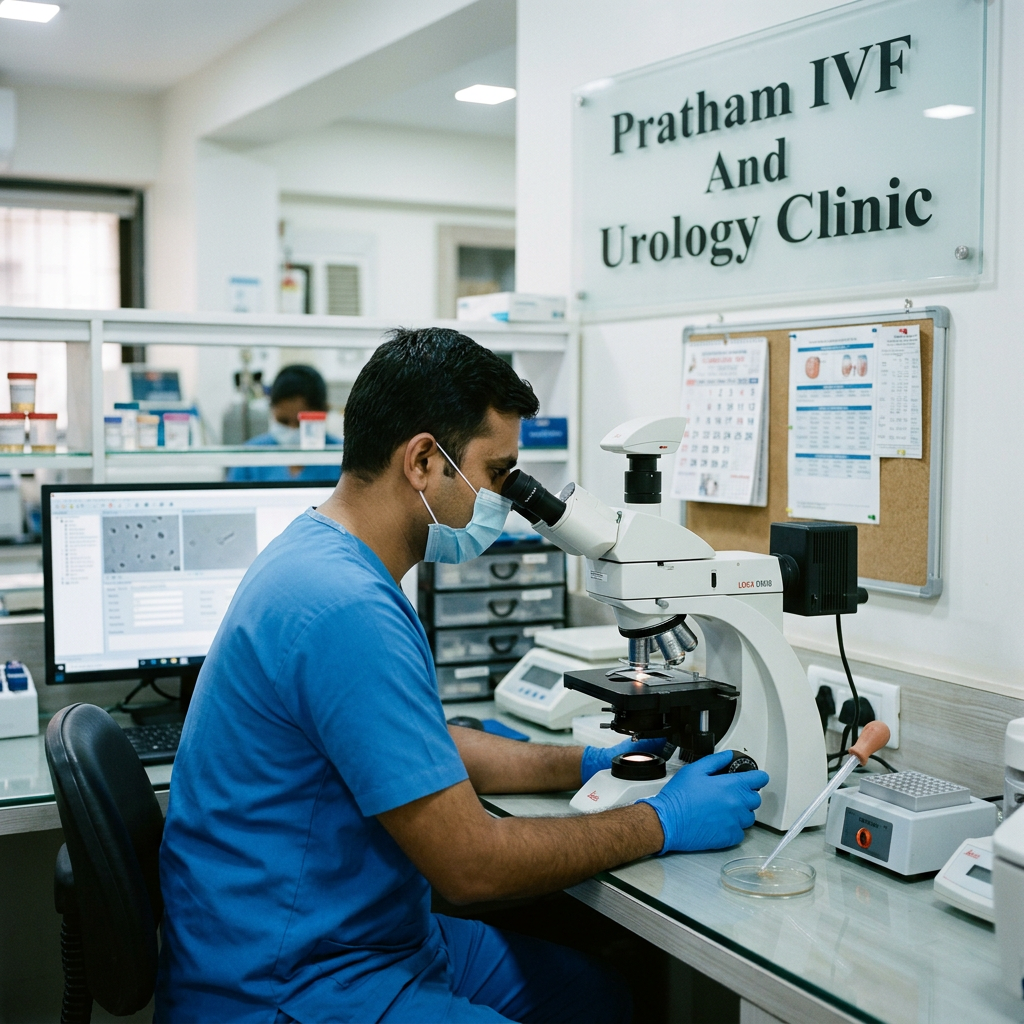
A semen analysis is the first and most important test of male fertility. It is simple and painless, but the result depends a lot on how the sample is collected and how carefully the lab follows standard methods. A poorly collected sample can make a healthy man look infertile, or hide a real problem.
This page explains how to prepare for a semen analysis, what the lab checks, and what happens next. Dr. Kalpesh Kapadia, consultant uroandrologist, arranges and interprets semen analysis at Pratham IVF & Urology Clinic, Vastrapur, Ahmedabad.
In short: Abstain from ejaculation for 2 to 7 days, collect the whole sample by masturbation into the sterile container provided, and get it to the lab within an hour. One abnormal result is repeated before any conclusions are drawn. The test should follow the WHO 2021 laboratory manual.
On this page
- When should a man have a semen analysis?
- How to prepare
- How the sample is collected
- What the lab checks
- Why the WHO 2021 standard matters
- If the result is abnormal
- Special tests sometimes added
- Frequently asked questions
- About Dr. Kalpesh Kapadia
- Book a semen analysis or consultation
When should a man have a semen analysis?
- After 12 months of trying for a baby without success, or 6 months if the female partner is 35 or older
- Before IVF or IUI
- When there are risk factors, such as undescended testes, varicocele, past chemotherapy, or testis injury
- To check the result of treatment, for example 3 months after varicocele surgery
- After vasectomy, to confirm that no sperm are present
How to prepare
| Do | Avoid |
|---|---|
| Abstain from ejaculation for 2 to 7 days before the test | A gap shorter than 2 days or longer than 7 days |
| Tell the lab about any fever or illness in the past 3 months | Testing during or straight after a fever, if it can be postponed |
| Tell the doctor about all medicines, supplements and any testosterone or steroid use | Starting new supplements just before the test |
| Pass urine and wash your hands and penis before collection | Lubricants, saliva or ordinary condoms (they can harm sperm) |
How the sample is collected
- The sample is collected by masturbation into a sterile, wide-mouthed container from the lab.
- Collect the whole sample. The first part contains the most sperm, so losing it can give a falsely low result. Tell the lab if any part was spilled.
- Collection is usually done in a private room at the lab.
- If home collection is allowed, keep the container close to body temperature and bring it to the lab within an hour. Strict protocol should be followed.
What the lab checks
| Measure | What it means |
|---|---|
| Volume | Amount of semen |
| pH | Acidity, which can hint at a blockage |
| Sperm concentration and total count | How many sperm |
| Motility | Percentage of sperm moving, and moving forward |
| Morphology | Percentage of normally shaped sperm |
| Vitality | Percentage of live sperm, checked when motility is very low |
| White blood cells | A possible sign of infection or inflammation |
For a full explanation of each value and the WHO 2021 reference limits, see [semen analysis report explained].
Why the WHO 2021 standard matters
The World Health Organization manual (6th edition, 2021) sets out how semen should be collected, examined and reported, so that results are accurate and can be compared. Labs that follow it count enough sperm, check motility at the right temperature, and use strict criteria for shape. Ask whether your lab follows the WHO 2021 methods.
If the result is abnormal
Semen results vary naturally from sample to sample. A single abnormal result is not a diagnosis. The usual next steps are:
- Repeat the test, ideally after a few weeks or more, with careful preparation
- See a male fertility specialist for history and examination
- Further tests if needed: hormones, genetic tests, ultrasound, or sperm DNA fragmentation
If no sperm are seen, the lab should spin the sample down (centrifuge it) and check the sediment before reporting azoospermia. See [azoospermia treatment].
Very low semen volume may need a urine test after ejaculation to check for semen going backwards into the bladder (retrograde ejaculation).
Special tests sometimes added
- Antisperm antibody test (MAR test): checks whether antibodies are coating the sperm
- Post-ejaculation urine test: for very low volume
- Semen culture: if infection is suspected
- Sperm DNA fragmentation: in selected couples. See [sperm DNA fragmentation testing].
Frequently asked questions(FAQs)
How many days of abstinence are needed before a semen analysis?
Most labs, following the WHO 2021 manual, ask for 2 to 7 days without ejaculation. Try to keep the same gap for any repeat test so the results can be compared.
Can I collect the sample at home?
Some labs accept a sample collected at home if it reaches the lab within about an hour and is kept close to body temperature. Ask the lab first, because the timing affects the motility result.
Can I use a normal condom or lubricant to collect the sample?
No. Ordinary condoms and most lubricants can harm sperm. Collect by masturbation into the sterile container the lab gives you, or ask about a special non-toxic collection condom.
What are normal semen analysis values?
The WHO 2021 manual gives lower reference limits such as 16 million sperm per mL, 39 million in total, 42% total motility and 4% normal forms. Results below these limits do not mean a man cannot father a child, and results above them do not guarantee fertility.
Is one abnormal semen analysis enough to diagnose male infertility?
Usually not. Sperm counts vary from week to week, and a recent fever or illness can lower them for up to about three months. An abnormal result is normally repeated before conclusions are drawn.
What happens if no sperm are seen in the sample?
The lab should spin (centrifuge) the sample and check again. If no sperm are found on at least two such tests, this is called azoospermia and needs a specialist evaluation.
How long does it take to get the semen analysis report?
Many labs report within a day or two. Ask the lab where you give the sample, because timings vary.
Should my wife and I both be tested?
Yes. When a couple is trying to conceive, both partners are usually evaluated at the same time. A semen analysis is the first step for the man.
Can lifestyle changes improve semen analysis results?
Stopping smoking, limiting alcohol, keeping a healthy weight and avoiding testosterone or anabolic steroids may help. Sperm take around three months to form, so changes show up slowly.
Do I need to see a doctor after the semen analysis?
Yes, if the result is abnormal or you have been trying to conceive for a year (six months if your partner is 35 or older). A specialist can explain the report and decide whether further tests are needed.
About Dr. Kalpesh Kapadia
Dr. Kalpesh Kapadia is a consultant urologist and andrologist in Ahmedabad, practising since 2012. He is a gold medalist and holds MCh (Genitourinary Surgery) . He evaluates male infertility at Pratham IVF & Urology Clinic, Vastrapur.
Book a semen analysis or consultation
- Clinic: Pratham IVF & Urology Clinic, Vastrapur, Ahmedabad
- Phone / WhatsApp: [PHONE — +91 99984 78633]
- Lab hours for sample collection: [HOURS — 10pm-5 pm]
- Report time: 2 hours
- Directions: Open in Google Maps
Medically reviewed by Dr. Kalpesh Kapadia, consultant urologist and andrologist. Last reviewed: 23 October 2026. This page is general information and does not replace a personal consultation.